It's been over a year and a half since I last had the time to write a blog post, or a "letter," as I like to call them. Today, I am breaking that silence to discuss a vital concept: owning the infrastructure of your business.
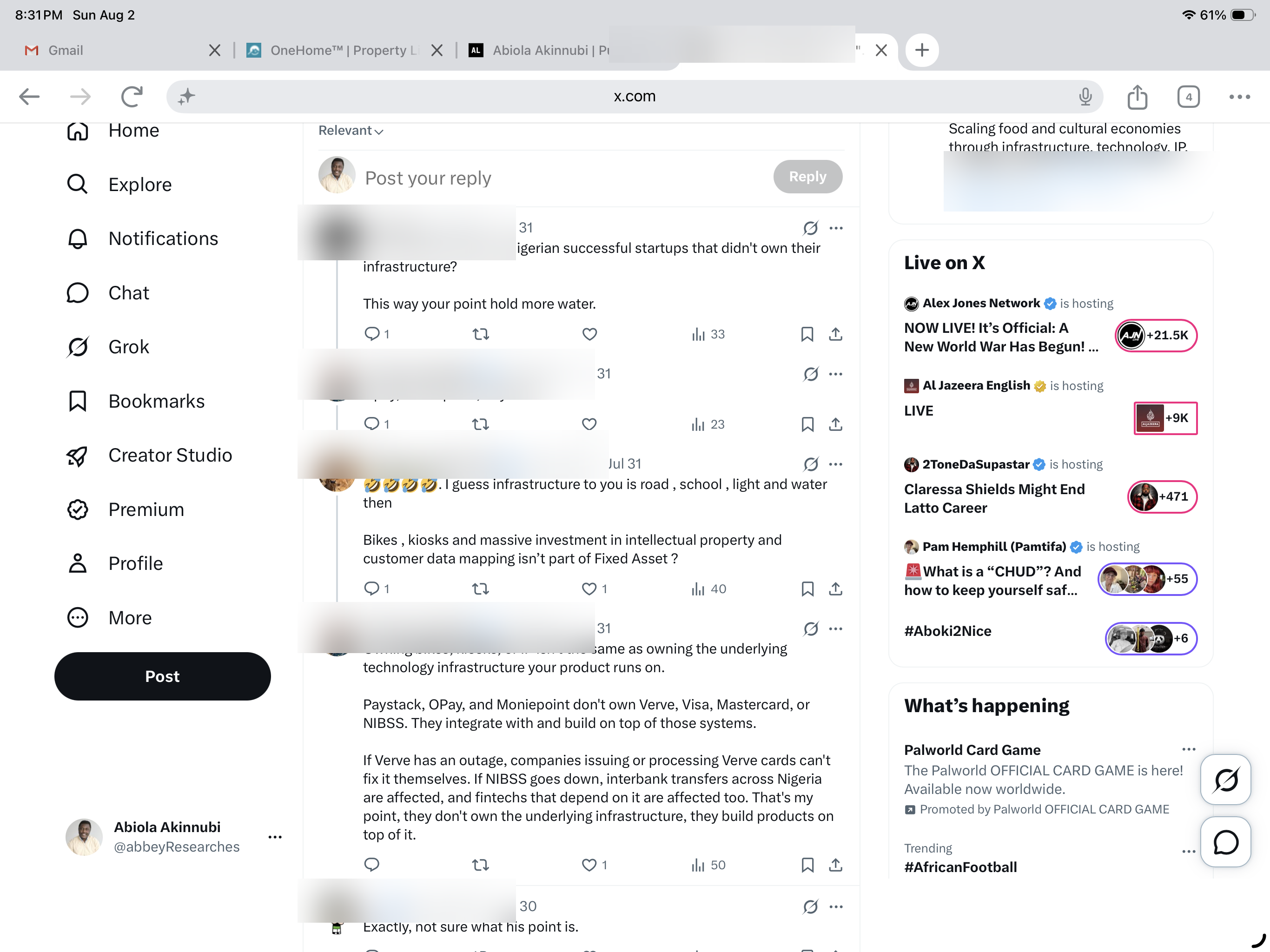
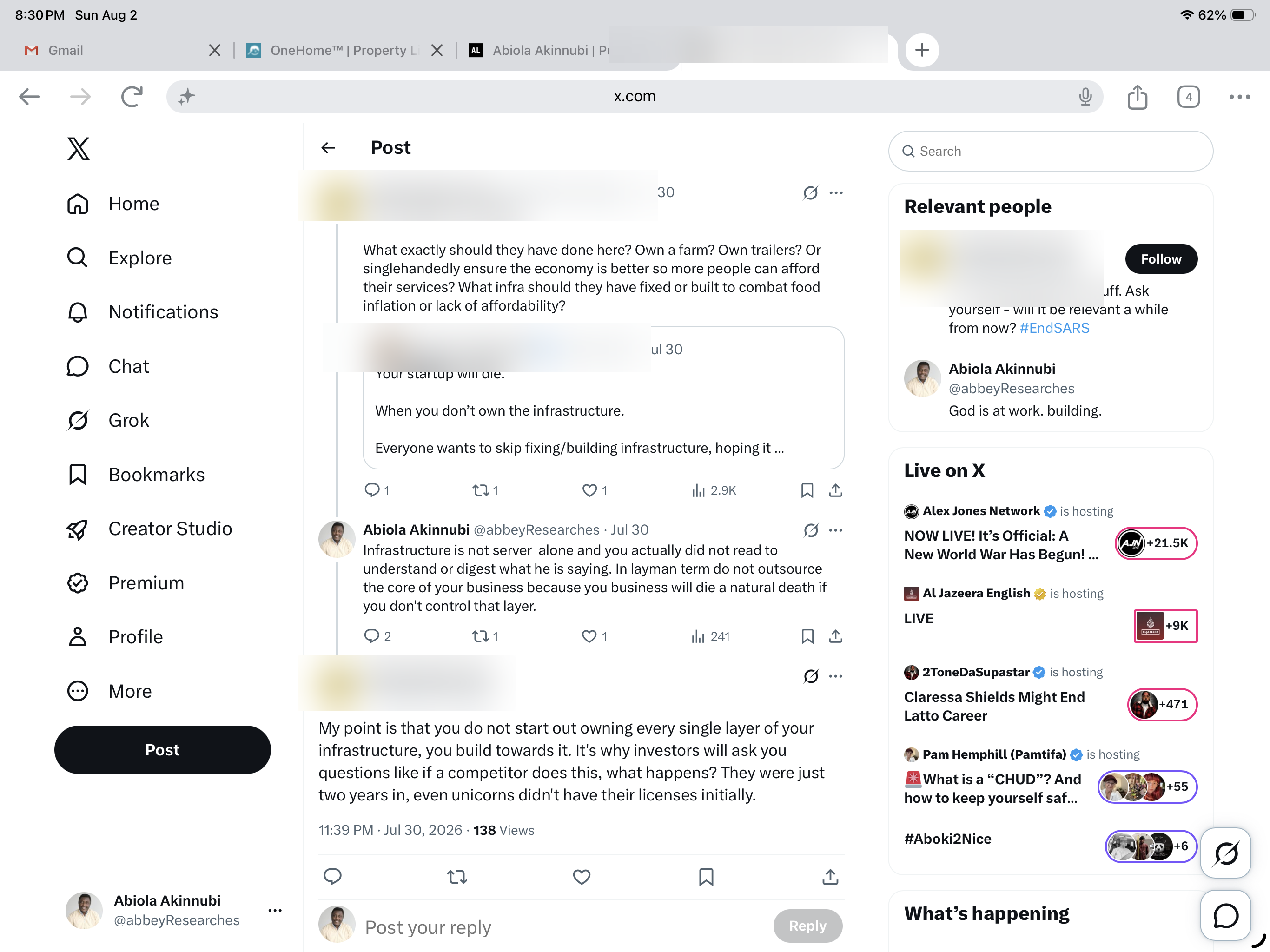
This has been my philosophy for years, and it was recently validated by a tweet I stumbled upon. The tweet argued that a business is designed to die if it is purely rent-seeking and fails to own its core infrastructure. Unfortunately, many people, especially those who view infrastructure strictly through a programming lens, attacked the author without grasping the full context. Some even thought he was taking a jab at a recently shut down delivery startup in Nigeria.
But stripped of the jargon, his point was simple and profound.
The Danger of Renting Your Core Infrastructure
Imagine you own a hair salon. For this salon to function, you need basic equipment. If you choose to outsource or rent every core item, like the hair dryers, the washbasins, and the fundamental tools of your trade, it won't take long before you are squeezed out of the market. You shouldn't have to pay rent via proxy for the core drivers of your service. By owning these essential assets by default, your business becomes durable and capable of weathering market storms.
Let's look at another example: a frozen food business. Suppose you decide to rent your commercial freezers, weighing scales, and everything else that allows you to sell fish effectively, just to maintain a temporary margin. Eventually, there is only so much revenue and profit you can squeeze out.
Your business might go viral. Everyone online might know your name. But behind the scenes, the books are bleeding. The operation runs at a persistent loss and slowly becomes unviable.
The "Build Fast" Dilemma
For every core service you provide, it is imperative that you own the core decision layer and the core infrastructure. This is what keeps you relevant.
Many startups and companies are quick to subscribe to third-party tools for everything. The mantra is usually, "We want to build fast and go to market quickly."
Yes, building fast is important. But you don't want to move so fast that you become completely dependent on a vendor who could one day pull the rug out from under you, or worse, become your direct competitor.
If a function is core to your business, you cannot afford to rely heavily on another layer's subscription. You need to start buying or building what is necessary to own that foundational layer. See for example every model companies whose business rely on hardware are now building their own hardware, they don't need to be as big as Nvidia but they only need to be as self-sufficient enough such that they are able to keep their margin in the long run.
Some Fictitious Analogy
Imagine you are building an employee management solution. Instead of building the employee appraisal feature yourself, you decide to simply plug into an established platform like Workday via an API. Your plan is to mark up the cost and make money off the integration.
Here is why this is a dangerous game:
- Margin Squeeze: Workday will charge you a fee, forcing you to mark up the price for your customers. Eventually, your customers will get tired of paying that premium.
- Surrendering Your Data: You are feeding your vendor valuable data and insights about your specific market segment.
- Losing Your Moat: If the vendor sees that your niche is highly profitable, they can easily announce a direct competing feature to bypass you entirely.
By taking the easy route, you paid them a lot of money, handed over your data, and completely lost your competitive moat.
The Golden Rule: When to Build vs. When to Buy
By and large, it is crucial to understand when to buy, when to outsource, and when to own a process end-to-end. Ask yourself: Is this the core of my business?
- If it IS core to your business: Own it. Do not outsource it. Do not rely on a subscription software to run the heart of your operation. Find a way to build it, even if that means hiring contractors to replicate a necessary system. Own the infrastructure.
- If it is vital, but NOT core: Outsource it. You do not want non-core tasks distracting you from your main mission. For example, a healthcare company has no business building custom HR software. Even with a million employees, their core strength is healthcare, not HR tech. Building it would be a massive distraction that stops them from innovating on their actual product.
Owning your infrastructure isn't about doing everything yourself; it is about owning the foundation of what makes your business yours.
Regards,
Abiola Akinnubi, PhD